
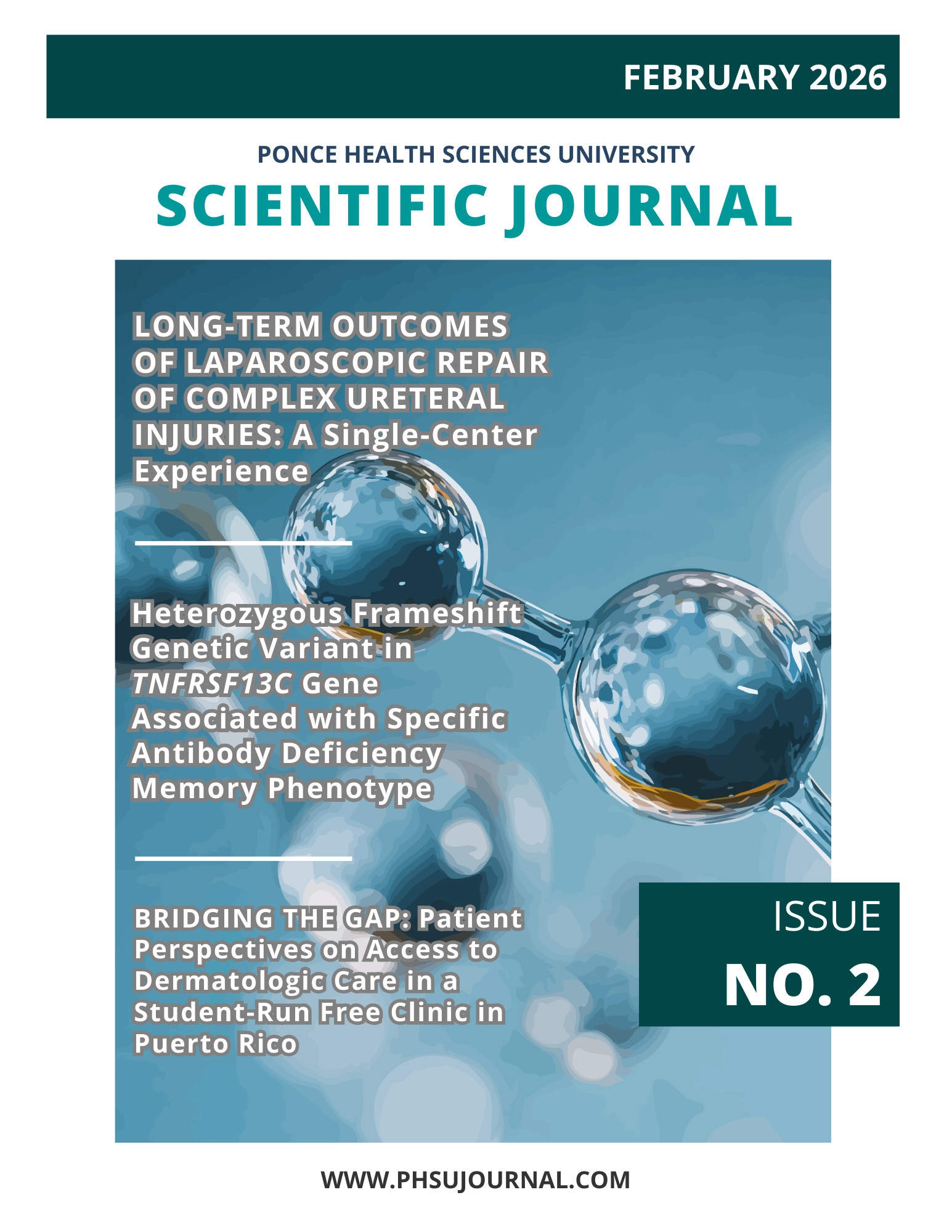
Heterozygous Frameshift Genetic Variant in TNFRSF13C Gene Associated with Specific Antibody Deficiency Memory Phenotype
DOI:
https://doi.org/10.71332/5y3gtw10Keywords:
Specific Antibody Deficiency, BAFFR, TNFRSF13CAbstract
Specific antibody deficiency (SAD) is a primary immunodeficiency disease (PID) in which patients present with recurrent sinopulmonary bacterial infections and decreased antibody responses to polysaccharide antigens following vaccination. SAD memory phenotype refers to an initial serologic and clinical response to the 23-valent polysaccharide vaccine followed by the loss of protective antibodies within six months. Various PID can present with diminished specific antibody responses, and it is known that patients with SAD can develop Common Variable Immunodeficiency (CVID) later in life. We present the case of a 7-year-old male with significant history of recurrent sinopulmonary infections since the age of two, who was diagnosed with SAD memory phenotype. A PID genetic panel revealed a TNFRSF13C genetic variant of unknown significance in Exon 3: c.534_543delinsAATAGCAGG (p.Ala179Ilefs*46). This variant results in a frameshift in the B cell-activating factor receptor (BAFFR) encoding gene. BAFFR is essential for the survival and maturation of transitional B cells into mature follicular and marginal zone B cells and has an important role in the development of T-independent antibody responses. BAFFR deficiency is known to be a genetic etiology for CVID and heterozygous missense polymorphisms have been implicated as risk factors for the development of CVID. The patient’s phenotype, which demonstrates inadequate T-independent antibody responses, correlates with the previously described phenotype of patients with TNFRSF13C variants. Here, we present a patient with SAD memory phenotype harboring a frameshift heterozygous variant in BAFFR. This case highlights the need to consider rare genetic causes in patients with PID.
References
1. Perez, E., Bonilla, F. A., Orange, J. S., & Ballow, M. Specific Antibody Deficiency: Controversies in Diagnosis and Management. Frontiers in immunology 2017, 8, 586. https://doi.org/10.3389/fimmu.2017.00586
2. Perez, E. E., & Ballow, M. Diagnosis and management of Specific Antibody Deficiency. Immunology and allergy clinics of North America 2020, 40(3), 499–510. https://doi.org/10.1016/j.iac.2020.03.005
3. Bonilla, F. A., Khan, D. A., Ballas, Z. K., Chinen, J., Frank, M. M., Hsu, J. T., Keller, M., Kobrynski, L. J., Komarow, H. D., Mazer, B., Nelson, R. P., Jr, Orange, J. S., Routes, J. M., Shearer, W. T., Sorensen, R. U., Verbsky, J. W., Bernstein, D. I., Blessing-Moore, J., Lang, D., Nicklas, R. A., … Joint Task Force on Practice Parameters, representing the American Academy of Allergy, Asthma & Immunology; the American College of Allergy, Asthma & Immunology; and the Joint Council of Allergy, Asthma & Immunology. Practice parameter for the diagnosis and management of primary immunodeficiency. The Journal of allergy and clinical immunology 2015, 136(5), 1186–205.e2078. https://doi.org/10.1016/j.jaci.2015.04.049
4. Orange, J. S., Ballow, M., Stiehm, E. R., Ballas, Z. K., Chinen, J., De La Morena, M., Kumararatne, D., Harville, T. O., Hesterberg, P., Koleilat, M., McGhee, S., Perez, E. E., Raasch, J., Scherzer, R., Schroeder, H., Seroogy, C., Huissoon, A., Sorensen, R. U., & Katial, R. Use and interpretation of diagnostic vaccination in primary immunodeficiency: a working group report of the Basic and Clinical Immunology Interest Section of the American Academy of Allergy, Asthma & Immunology. The Journal of allergy and clinical immunology 2012, 130(3 Suppl), S1–S24. https://doi.org/10.1016/j.jaci.2012.07.002
5. Tangye, S. G., Al-Herz, W., Bousfiha, A., Cunningham-Rundles, C., Franco, J. L., Holland, S. M., Klein, C., Morio, T., Oksenhendler, E., Picard, C., Puel, A., Puck, J., Seppänen, M. R. J., Somech, R., Su, H. C., Sullivan, K. E., Torgerson, T. R., & Meyts, I. Human Inborn Errors of Immunity: 2022 Update on the Classification from the International Union of Immunological Societies Expert Committee. Journal of clinical immunology 2022, 42(7), 1473–1507. https://doi.org/10.1007/s10875-022-01289-3
6. Warnatz, K., Salzer, U., Rizzi, M., Fischer, B., Gutenberger, S., Böhm, J., Kienzler, A. K., Pan-Hammarström, Q., Hammarström, L., Rakhmanov, M., Schlesier, M., Grimbacher, B., Peter, H. H., & Eibel, H. B-cell activating factor receptor deficiency is associated with an adult-onset antibody deficiency syndrome in humans. Proceedings of the National Academy of Sciences of the United States of America 2009, 106(33), 13945–13950. https://doi.org/10.1073/pnas.0903543106
7. Sevdali, E., Block Saldana, V., Speletas, M., & Eibel, H. BAFF receptor polymorphisms and deficiency in humans. Current opinion in immunology 2021, 71, 103–110. https://doi.org/10.1016/j.coi.2021.06.008
8. Kakkas, I., Tsinti, G., Kalala, F., Farmaki, E., Kourakli, A., Kapousouzi, A., Dimou, M., Kalaitzidou, V., Sevdali, E., Peristeri, A. M., Tsiouma, G., Patiou, P., Papadimitriou, E., Vassilakopoulos, T. P., Panayiotidis, P., Kioumi, A., Symeonidis, A., & Speletas, M. TACI Mutations in Primary Antibody Deficiencies: A Nationwide Study in Greece. Medicina 2021, 57(8), 827. https://doi.org/10.3390/medicina57080827
9. Salzer, U., Chapel, H. M., Webster, A. D., Pan-Hammarström, Q., Schmitt-Graeff, A., Schlesier, M., Peter, H. H., Rockstroh, J. K., Schneider, P., Schäffer, A. A., Hammarström, L., & Grimbacher, B. Mutations in TNFRSF13B encoding TACI are associated with common variable immunodeficiency in humans. Nature genetics 2005, 37(8), 820–828. https://doi.org/10.1038/ng1600
10. Martinez-Gallo, M., Radigan, L., Almejún, M. B., Martínez-Pomar, N., Matamoros, N., & Cunningham-Rundles, C. TACI mutations and impaired B-cell function in subjects with CVID and healthy heterozygotes. The Journal of allergy and clinical immunology 2013, 131(2), 468–476. https://doi.org/10.1016/j.jaci.2012.10.029
11. Remiker, A., Bolling, K., & Verbsky, J. Common Variable Immunodeficiency. The Medical clinics of North America 2024, 108(1), 107–121. https://doi.org/10.1016/j.mcna.2023.06.012
12. Bonilla, F. A., Barlan, I., Chapel, H., Costa-Carvalho, B. T., Cunningham-Rundles, C., de la Morena, M. T., Espinosa-Rosales, F. J., Hammarström, L., Nonoyama, S., Quinti, I., Routes, J. M., Tang, M. L., & Warnatz, K. International Consensus Document (ICON): Common Variable Immunodeficiency Disorders. The journal of allergy and clinical immunology. In practice 2016, 4(1), 38–59. https://doi.org/10.1016/j.jaip.2015.07.025
13. Wilson, S. P., & Ballas, Z. K. Progression of specific antibody deficiency to common variable immunodeficiency. Journal of Allergy and Clinical Immunology 2010, 125*(6), 1393-1396. https://doi.org/10.1016/j.jaci.2009.12.989
14. Pieper, K., Rizzi, M., Speletas, M., Smulski, C. R., Sic, H., Kraus, H., Salzer, U., Fiala, G. J., Schamel, W. W., Lougaris, V., Plebani, A., Hammarstrom, L., Recher, M., Germenis, A. E., Grimbacher, B., Warnatz, K., Rolink, A. G., Schneider, P., Notarangelo, L. D., & Eibel, H. A common single nucleotide polymorphism impairs B-cell activating factor receptor's multimerization, contributing to common variable immunodeficiency. The Journal of allergy and clinical immunology 2014, 133(4), 1222–1225. https://doi.org/10.1016/j.jaci.2013.11.021
15. Ng, L. G., Sutherland, A. P., Newton, R., Qian, F., Cachero, T. G., Scott, M. L., Thompson, J. S., Wheway, J., Chtanova, T., Groom, J., Sutton, I. J., Xin, C., Tangye, S. G., Kalled, S. L., Mackay, F., & Mackay, C. R. B cell-activating factor belonging to the TNF family (BAFF)-R is the principal BAFF receptor facilitating BAFF costimulation of circulating T and B cells. Journal of immunology 2004, 173(2), 807–817. https://doi.org/10.4049/jimmunol.173.2.807
16. Sakai, J., & Akkoyunlu, M. The Role of BAFF System Molecules in Host Response to Pathogens. Clinical microbiology reviews 2017, 30(4), 991–1014. https://doi.org/10.1128/CMR.00046-17
17. Sasaki, Y., Casola, S., Kutok, J. L., Rajewsky, K., & Schmidt-Supprian, M. TNF family member B cell-activating factor (BAFF) receptor-dependent and -independent roles for BAFF in B cell physiology. Journal of immunology 2004, 173(4), 2245–2252. https://doi.org/10.4049/jimmunol.173.4.2245
Downloads
Published
Issue
Section
License
Copyright (c) 2026 Mariana Acuña, Dr. De Jesús Rojas, Dr. Fernández Dávila (Author)

This work is licensed under a Creative Commons Attribution 4.0 International License.
Authors retain copyright of their articles. All works are published under the Creative Commons Attribution 4.0 International License (CC BY 4.0), which permits unrestricted use, distribution, and reproduction in any medium, provided the original author and source are properly cited.