
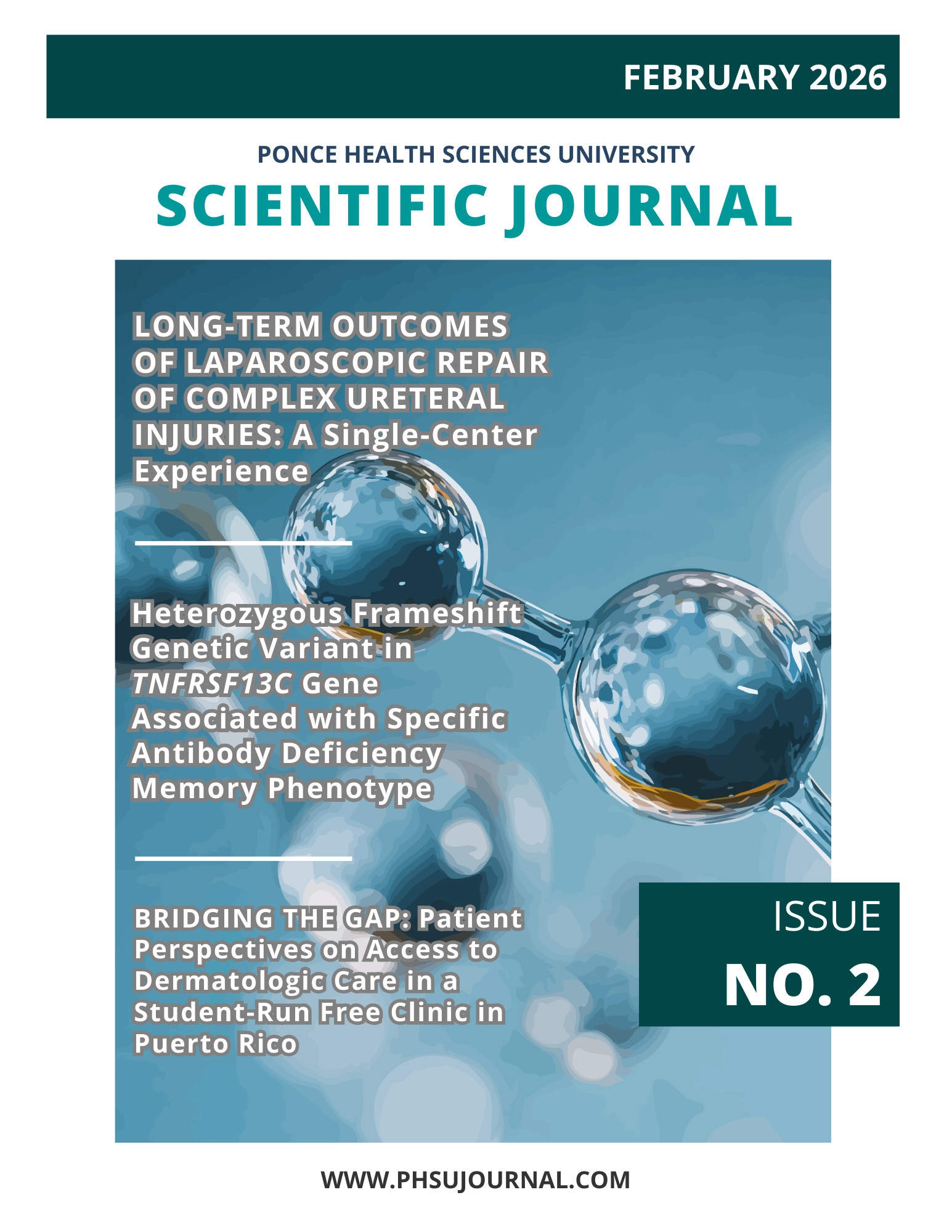
Bridging the Gap: Patient Perspectives on Access to Dermatologic Care in a Student-Run Free Clinic in Puerto Rico
DOI:
https://doi.org/10.71332/rxamt829Keywords:
Dermatology, Student Run Free Clinic, Health Disparities, Community OutreachAbstract
Underserved communities face persistent barriers to dermatologic care, yet little is known about their perceptions of barriers to access, knowledge gaps, and motivations to seek care. We conducted a two-day student-run free clinic (SRFC) in Puerto Rico, providing free dermatologic services and administering a Spanish-language questionnaire to assess patient demographics, sun protection behaviors, barriers to care, and perceived impact of the clinic. Of 350 patients, 267 (76.3%) completed the survey. The cohort was predominantly female (91.4%) and Hispanic (97.8%), with 72.7% reporting a dermatologic condition, but over half (51.3%) having never seen a dermatologist. Common barriers included difficulty obtaining appointments (42.5%) and lack of self-perceived need (38.8%). Only 6.4% felt very informed about skin cancer, and 26.6% reported never practicing sun protection. Twelve biopsies revealed both benign and malignant diagnoses, including mammary Paget’s and melanoma in situ. Patients who self-identified as informed about skin cancer reported more frequent use of sun protection and greater engagement in sun-avoidant behaviors. Most participants cited the clinic’s no-cost services as a major factor improving healthcare access. Our findings highlight the dual burden of high dermatologic disease prevalence and limited access to specialty care in Puerto Rico, exacerbated by a physician shortage and socioeconomic barriers. SRFCs can help reduce dermatologic workforce burnout by supplementing clinical capacity, allowing dermatologists to focus on complex cases while medical students assist with triage, education, and basic care delivery. Incorporating medical students in dermatologic outreach may amplify impact by expanding services capacity and promoting awareness and education in underserved populations.
References
O’Connell K, Bartholomew E, Villanueva A. Addressing Dermatologic Health Disparities: Characterization of a Free Dermatology Clinic for an Uninsured Population. J Stud-Run Clin. 2021;7(1). doi:10.59586/jsrc.v7i1.215
2. Niu Z, Tortolero-Luna G, Lozada C, Heckman CJ, Coups EJ. Correlates of Sun Protection Behaviors Among Adults in Puerto Rico. Int J Behav Med. 2022;29(1):36-45. doi:10.1007/s12529-021-09991-z
3. Koumaki D, Evangelou G, Gregoriou S, et al. Skin Cancer Knowledge, Sun Exposure, Photoprotection Behavior, and Perceived Barriers Associated with Skin Cancer Types in a Greek Cohort: A Cross-Sectional Study on the Island of Crete. Cancers. 2024;16(24):4226. doi:10.3390/cancers16244226
4. Santiago-Santiago AJ, Rivera-Custodio J, Mercado-Ríos CA, et al. Puerto Rican physician’s recommendations to mitigate medical migration from Puerto Rico to the mainland United States. Health Policy OPEN. 2024;7:100124. doi:10.1016/j.hpopen.2024.100124
5. Evidence Indicates a Range of Challenges for Puerto Rico Health Care System. Department of Health & Human Services USA; 2017. Accessed May 15, 2025. https://aspe.hhs.gov/sites/default/files/migrated_legacy_files/171926/PuertoRico_Assessment.pdf
Downloads
Additional Files
Published
Issue
Section
License
Copyright (c) 2026 María Vázquez-Machado, Lara Diez-Asad, Chavely Calderón Casellas, Eric Graulau, Dr. Santiago-Soltero, Andrés Ortiz-Franco, Sofía Díaz, Deborah Colón-Lara, Dr. Blanco (Author)

This work is licensed under a Creative Commons Attribution 4.0 International License.
Authors retain copyright of their articles. All works are published under the Creative Commons Attribution 4.0 International License (CC BY 4.0), which permits unrestricted use, distribution, and reproduction in any medium, provided the original author and source are properly cited.